State of Our City 2026
State of Our City Summary: Confronting the Multiple Crises of Our Time
In 1996 Sustainable Calgary launched the State of Our City (SOOC) sustainability indicators project. Our first report, SOOC 1998, identified two critical issues that needed attention – overconsumption of resources and socio-economic inequities in our city. Almost thirty years on, the evidence suggests that the state of these critical domains has not improved. Equally troublesome, indicators in the Community domain, historically a strength of our city, are deteriorating.
Over this time, Calgary has seen a lot of change and progress and remains a very affluent city with an enviable quality of life, but an assessment of the 40 social, ecological, and economic indicators clearly demonstrates that the lifestyle we enjoy in Calgary is not sustainable.
Our failure to meet the sustainability challenge is systemic across social, economic, and environmental domains. The indicators reflect poorly functioning democratic institutions, resource-intensive city-building, failure to reverse growing inequality, and increasing deprivation of the most marginalized in our city – all while continuing to be seduced by material consumption and the economic growth required to fuel it. At the same time, we find ourselves sheltered from but not immune to an escalating global crisis – gross inequality, social polarization, the rise of authoritarianism and militarism, accelerating climate disruption, and rising concern over almost completely unregulated social media and artificial intelligence and the billionaires who control them.
This polycrisis is not a fanciful creation of the political left or alarmists. In response to the unraveling of the existing world order, our federal government is taking steps (though tentative and modest) for the reorganization of our entire economy and of our political alignments and is opening the doors to a larger national conversation about building a better world.
In this time of crisis, the priorities for all levels of government should be increasing affordable housing and food security, reversing sprawl, providing education and healthcare for all, realigning toward active and transit-oriented transportation, shoring up and protecting existing infrastructure, and creating jobs for the future, not of the past. We need policy, budgets, and implementation to focus squarely on these priorities.
What can we do in our own lives? In our estimation, this is a time to focus on the basics. We can put aside our cellphones and screens and instead meet and talk to each other at home, in our neighbourhoods, and across our city at work, on the streets, and in public spaces. We can eat well: research clearly demonstrates that plant-based whole food diets are better for our own health and for the health of our planet. Get active. Walk and wheel; use transit. Hang up our car keys, using them only when absolutely necessary. Resist the urge to go into “me first” mode. Live simply, create community. We must widen our circle of care to encompass our fellow citizens in the global village, and the living Earth itself.
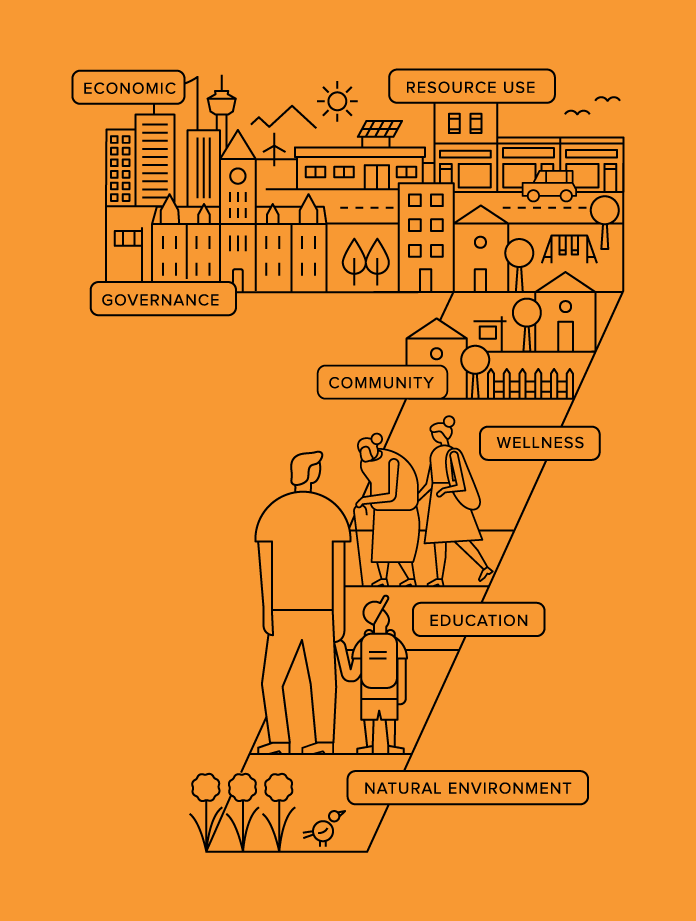
Our Story in 7 Domains
Calgarians take pride in our sense of Community. For the first time since we began reporting on the SOOC, this domain is moving in the wrong direction. Survey data suggest a deteriorating sense of belonging, of trust in each other, and of confidence in our institutions. Levels of physical activity have stagnated, with almost half of us not getting enough exercise to maintain and improve health. There has been a significant decline in rates of volunteerism since 2020. Person and property crime has remained relatively stable over the past 20 years, but we are seeing unacceptable and persistent levels of gender-based violence. The one bright spot in this domain is the continued strength, vibrancy, and diversity of the arts, which has rebounded from the pandemic years.
All Economic domain indicators are in unsustainable territory. Negative trends masked in the boom years are now being exposed. We have one of the highest income gaps of any large city in Canada, and the gap has been growing consistently for over 40 years. At minimum wage, a single parent with two children would still be required to work over 65 hours a week to make ends meet. Rents have increased substantially since 2020. Having led the country in employment creation for much of the past 30 years, we now have one of the highest rates of unemployment of any large city in Canada, and job quality (wages, benefits, paid time off for sickness, job security) is an issue for many working Calgarians.
Our timid moves away from reliance on fossil fuels have stalled since 2020, with our reliance on oil and gas near record levels.
The Education system has performed well over the past 30 years. Though international test scores have been decreasing over the past 20 years, our grade schools have some of the best international test results compared to Canadian averages and to other OECD countries. However, reduced funding is putting severe pressure on teachers’ ability to meet the demands of a more diverse and challenging generation of students. Rates of adult literacy have deteriorated since the 2020 report: almost half of Albertans between 16 and 65 years of age are functionally illiterate. Post-secondary education has become more expensive and, consequently, more exclusive. Since 2020 the introduction of a national childcare program has created more accessible and affordable daycare, making a real difference for families. Still, salaries for early childhood education professionals hover at or below a living wage. We can take pride in the Calgary Public Library. Our libraries are thriving, having recovered from the pandemic years and a serious cyberattack. They have responded to growing demands beyond the traditional lending of books. On any given day, the Central Library is a diverse hive of activity and remains accessible and welcoming to all Calgarians.
Calgarians are among the healthiest people on the planet. However, many of our Wellness indicators are trending in the wrong direction, are stalled, or are moving too slowly toward improvement. Evidence suggests that the diets of most youth feature unhealthy levels of ultra-processed foods, and obesity remains a significant health issue. The incidence of low birthweight has risen consistently for 20 years. We have more low-weight births than anywhere else in Canada, and we compare unfavourably with Europe. Rising rates of self-reported stress and mental illness are troubling. There has been no discernable shift of healthcare budgets away from treating disease and toward preventing it. Population health varies significantly across Calgary communities, with individuals’ health closely associated with social determinants – income, education level, gender identity, ethnicity, and proximity and exposure to environmental harms.
While there is room for improvement, Calgarians are lucky to live in a high-quality Natural Environment, with four of six indicators being sustainable or trending toward sustainability. Water quality, as measured by fecal coliforms downriver of the city, shows improvement over the past 20 years, but associated tributaries of the Bow are showing signs of stress. Per capita water consumption is at a 20-year low, but total consumption of this finite resource continues to climb as the city grows. With respect to pesticide usage, fewer hectares are being treated, but active ingredient intensity of application has increased. The City of Calgary has developed programs and targets for biodiversity and ecological integrity, and both are trending in a positive direction. Most critically, greenhouse gas emissions continue to move us toward irreversible tipping points, threatening to make our planet much less welcoming to our species. City-wide emissions have decreased but the emissions produced by the oil and gas industry, the commodity that continues to drive Calgary’s economy, have increased rapidly.
Resource Use indicators are almost universally in unsustainable territory. Calgary is living well beyond its ecological means. Our ecological footprint far exceeds our fair share of the Earth’s available resources and is probably the largest of any Canadian city. If everyone on the planet consumed as we do, we would need more than five planets’ worth of resources. Our total energy consumption and per capita consumption both continue to grow. Our city is far from achieving its own targets of balancing growth in established neighbourhoods versus new suburbs, with that balance worsening in recent years. Our overall population density, while slowly increasing, is far from sustainable and leaves us almost completely dependent on the private automobile and vulnerable to long-term social, ecological, and environmental costs associated with that dependence. Steady improvement in numbers taking transit to work through the first decade of the millennium has reversed in recent years. The cost of infrastructure to service this rapidly expanding city is growing faster than our capacity to fund it. The only good news story in this domain – total per capita waste to landfill – is down over 50% since 2001, with waste-diversion programs delivering results.
Three of five Governance indicators are trending unsustainably. Our democracy is under strain. Our elected leaders too often do not reflect who we are or what we value. Rarely do winning councillors garner votes from more than 20% of eligible voters. Money continues to play too big a role in politics. Between 1995 and 2025, campaign spending by the winning mayoral candidate increased almost 6 times. Since 2020 we have seen some improvement in how we value cultural diversity. Though women are sadly underrepresented on City Council, there has been improvement in the number of women in other sectors. Visible minorities in positions of power and influence are well below their numbers in the general population, but their presence and influence continue to grow. Calgarians’ satisfaction with the planning process is lower than it was in 2020 but still above the 20-year average. We don’t have enough data to definitively assess fiscal responsibility. Property tax has grown at a slightly greater rate than inflation since 2000 but remains among the lowest in the country. The City’s operating budget has grown at a rate slightly less than that of inflation.
Calgary in the Global Village: Taking Stock of Our Place in the World
An assessment of our 40 indicators supports our call for a radical reorganization of our way of life – in Calgary and globally. The capitalist economic model of endless growth, the science and technology that formed the foundation of the Industrial Revolution, and the colonial exploitation that made it so profitable are providing diminishing returns, igniting a crisis that many see as existential for modern civilization and perhaps even for our species. While this may sound alarmist, the evidence from the very scientific enterprise that helped build our modern world is compelling.
We need to recognize that even as we sit in the privileged position of benefiting more than almost any other city on the planet from this historical evolution and current state of affairs, millions of others are already living with the consequences. The basis of our affluence – fossil fuels – and our subsequent ability to appropriate much greater than our fair share of the Earth’s resources to produce all the modern products that underwrite our way of life contribute to the multiple crises confronting us. The good news is that, according to the 2020 World Happiness Report and the OECD Better Life Index, once the basics of life are taken care of, it is the quality of human relationships that determines happiness and life satisfaction, not material affluence.
The most recent WWF Living Planet Report 2024 finds that “our world is reaching dangerous tipping points” where “the average population of vertebrate species has fallen 73% from 1970 to 2020” and “about 71% of all agricultural land is currently used for grazing livestock, with a further 11% used to grow crops for animal feed.” The report urges us to “tackle the causes of nature’s destruction by transforming our food, energy and finance systems” and “to conserve and restore nature.” In line with the EAT-Lancet Commission, it encourages “healthy planet-friendly diets”: eating more plant-based foods and fewer animal products is better for our health and better for the planet.
The Stockholm Resilience Centre reports that seven of nine planetary boundaries have been breached. The most serious exceedances include greenhouse gases in the atmosphere, biosphere integrity, and the introduction of novel synthetic substances that Earth’s systems are unable to assimilate (e.g., genetic engineering, plastics). Four other systems have breached the boundaries – ocean acidification, biogeochemical flows of phosphorous and nitrogen used in agriculture, land system change (deforestation and urbanization), and alteration of freshwater systems.
The Potsdam Institute’s Planetary Health Check 2025 reports that human activities have collectively pushed Earth beyond its “safe operating space.” For over 10,000 years, an era known as the Holocene, humanity has thrived within a period of climatic stability and a resilient Earth system – providing conditions that enabled the rise of agriculture, urbanization, and our complex modern civilization. However, since the mid-20th century, we have entered a new epoch, sometimes called “The Great Acceleration, … in which human activity has become the dominant force shaping the Earth system.”
The International Panel on Climate Change (IPCC) has declared that “human activities … have unequivocally caused global warming,” which “has led to widespread adverse impacts and related losses and damages to nature and people” and that “vulnerable communities who have historically contributed the least to current climate change are disproportionately affected.”
Climate change is an existential threat to humans. The good news is that what makes for a healthier, more livable, more just city is exactly what we need to tackle climate change.
The United Nations Global Water Bankruptcy Report, led by Canadian researchers, identifies 'water bankruptcy’ as a persistent post-crisis condition of a human–water system in which long-term water use has exceeded renewable inflows and safe depletion limits.” This has caused “irreversible degradation such that previous levels of water supply and ecosystem functions cannot realistically be restored.” Among the regions identified as facing bankruptcy is the American Southwest – the Colorado River and its reservoirs. With the effects of climate change, including receding glaciers and more frequent drought and flood, Calgary is not immune to these changes.
There is growing critique of positioning economic growth as a proxy for well-being. A more progressive movement within the economics profession is calling for a focus on no-growth economics as a pathway to flourishing in a finite world. Herman Daly was one of the first to describe our current state of affairs as “non-economic growth” – that is, economic growth as doing more harm than good. Contemporary ecological economists – including Tim Jackson, Giorgos Kallis, Kate Raworth, Clara Mattei, Peter Victor and Jason Hickel – now propose a degrowth economy, along with a framework for a contracting economy that nevertheless delivers livelihoods and well-being.
According to the 2026 World Inequality Report, today’s accelerating global inequality requires “urgent attention.” As a result of political and institutional choices, “the wealthiest 0.001% alone … owns three times more wealth than the entire bottom half of humanity combined.” As a result of this unprecedented control of financial power by fewer than 60,000 individuals, “billions remain excluded from even basic economic stability.”
In 2026, the UN Special Rapporteur on extreme poverty and human rights wrote that “the widely held belief that increasing economic growth will solve global poverty is wrong and leading the world down a dangerous path of spiralling inequalities and environmental breakdown. We must urgently change course, abandoning GDP as a measure of progress and refocusing on what truly makes a difference to people’s lives.”
Since the 2020 SOOC Report, authoritarianism has emerged over all of humanity. We face rising authoritarianism, militarization, and might makes right, and our international institutions are being sidelined and are under attack. This should not have come as a surprise. In 2004, in Dark Age Ahead, the celebrated urban visionary Jane Jacobs warned of the dangers to civilization of environmental crisis, racism, and the growing gulf between rich and poor. Likewise, in 2010, in Equality or Barbarism, Ed Broadbent, one of the most respected Canadian statesmen of the post–WWII era, warned of a coming barbarity on the heels of the unjust economic system.
We either turn a blind eye or simply accept growing human rights violations, like the ongoing genocide in Gaza playing out on our screens daily. The rule of law is fractured, with powerful nations making their own rules and intervening unlawfully in other nations with disdain for our collective efforts in the United Nations. Western nations routinely resort to violence to guarantee access to resources, with devastating consequences, particularly to those in the Middle East, Afghanistan, Iraq, Palestine, and, most recently, Iran. None of this can be sustained ecologically, politically, or morally. Canadian military historian Gwynne Dyer writes that since at least the mid-1800s, nations have subscribed to the dictum that “war is merely a continuation of politics by other means.” He argues that we can no longer afford that kind of politics. “We have reached a point where our moral imagination must expand again to embrace the whole of mankind, or else we will perish.” Violence in any form – domestic, schoolyard, against nature, or war – is intolerable. War is a tragic failure of civilization, and the abolition of war is vital for a sustainable world.
According to the Stockholm International Peace Research Institute (SIPRI), humanity spent, collectively, $1.8T on the military in 2018. The United States alone spent almost $650B – as much as the next 26 nations combined. In 2016 SIPRI researchers estimated that just 4% of annual military spending globally could fund the estimated annual costs to achieve all 17 UN Sustainable Development Goals.
A growing list of renowned mainstream economists – including Thomas Piketty, Robert Reich, and Nobel economists Paul Krugman and Joseph Stiglitz – argue that inequality is perhaps the most problematic characteristic of today’s capitalist economies. Most of these authors demonstrate the links between economic inequality, deteriorating democracy, evaporating trust in our democratic institutions, and health and social outcomes. In The Spirit Level, Richard Wilkinson and Kate Pickett demonstrate that inequality explains uneven social and health outcomes better than any other factor and that in unequal societies, wellness suffers – even for the wealthiest.
Our species, Homo sapiens, has generally considered itself superior to the rest of nature. We tell ourselves a story about evolution being a process toward ever more complex life forms, with humans at the top of the pyramid or the “great chain of being.” At worst, we tell ourselves that the rest of nature exists as nothing more than a resource for our development and progress. Humans are certainly unique, as is every one of the millions of species on the planet. But as the Indigenous peoples of North America have insisted from first contact, other species are “all our relations.” Sustainability challenges us to look beyond the myth of human exceptionalism and to find ways of living in harmony with the diversity of life on Earth.
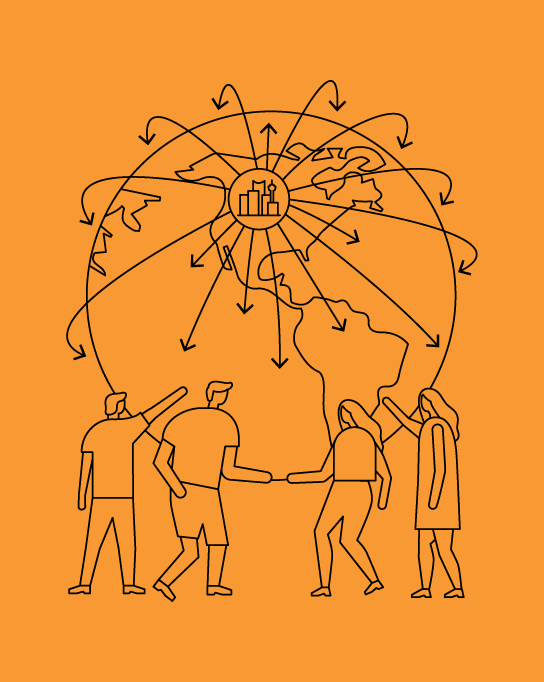
Our ecological footprint (EF) indicator is key to understanding our role, as Calgarians, in all of this. The EF analysis was created by Canadian ecologist William Rees. As Rees has pointed out, our cities are wholly dependent upon a land area far greater than their political boundaries. While the popular imagination of cities is as engines of growth, innovation, and creativity, they are also parasitic on their hinterlands. The flow-through of energy and resources required to maintain the incredible metabolism of cities requires a harvest of resources not only from their adjacent geographies but also from places around the globe. As the EF concept makes clear, a modern affluent city like Calgary by necessity appropriates land and resources from every corner of the globe. Calgarians appropriate much more than our fair share of the Earth to live as we do. Our insatiable appetite for fully loaded pickups, super-sized houses, sun-and-surf holidays, and endless consumer toys and trinkets is sated at the expense of the majority of our fellow human beings. We consume more than the Earth can bear, and we alter basic life support systems through the burning of fossil fuels.
“The deepest crises experienced by any society are those moments of change when the story becomes inadequate for meeting the survival demands of a present situation.”
– Ecologian Thomas Berry (2000)
The Way Forward: Practice Compassion, Live Simply, Create Community
As Canadians and as Calgarians, we are intimately tied to what, in the 1960s, Canadian Marshall McLuhan coined “the global village.” Our prosperity is defined by the nature of our relationships with our neighbours in that global village. Over the past 75 years, during a period some refer to as the Anthropocene, the nature of those economic and social relationships have become untenable socially, ecologically, and economically. We need a new story to guide how humans thrive on this planet.
For many, our instinct is to attempt to shield ourselves and our loved ones from these accelerating crises, to become more individualistic and more protective of our own comforts and privileges, rather than to strengthen our collective action to confront them.
Cities can be at the forefront of addressing the critical issues that humanity faces, but this will only happen by design: there is nothing inherent in the nature of a city that ensures it. Fortunately, Calgary has a growing design culture and expertise endowed from years of prosperity. We need our buildings, neighbourhoods, transportation, the city, and the region designed to sustain us through these multiple crises. We need to elevate the aspirations for a just and inclusive society embodied in our library system and in the creativity and imagination of our diverse community of artists. As Lewis Mumford wrote, the new story of cities will require “a fresh dedication to the cosmic and ecological processes that enfold all being … and thereby to the highest degree possible achieve the illumination of consciousness, the stamp of purpose, the colour of love.”
Here in Calgary, the change we need is not rocket science. Above all, change requires social solidarity and political will. We need to stop the outward expansion of our city; to live in more tightly knit, compact communities; to make walking, biking, and transit our preferred modes of travel. We can draw on the abundance of wind and solar energy and leave fossil fuels in the ground. We can forgo long-distance travel to the latest tourist meccas and instead enjoy the spectacular mountains and river valleys, prairie landscapes, and urban parks of our city and bioregion. Each of these actions will save money, save lives, and protect our sacred Earth.
We can strengthen the links of public health to climate action. A growing body of evidence clearly demonstrates the pollution of the air we breathe and the water we drink, the plastics and toxins that find their way into the Earth and our very bodies, excessive noise and heat, and our addiction to the private automobile. The damage has been found in the bodies of the elderly, young adults, children, infants (newborn and in-utero), and pregnant mothers. It worsens everything from sleep deprivation to cardio-vascular and kidney disease, pulmonary disease, depression, anxiety, and dementia.
We know disease prevention is far more effective than treating disease. Cities have an outsized role to play here, through housing and transportation policy, neighbourhood and greenspace design, and regulation of air, water, and soils. How we build our cities can either create conditions for longer healthier lives or make us sick and shorten our lives.
We will need to beat the all-too-common swords of anger and hate into ploughshares of compassion and courage. Compassion … to reach out to those with whom we disagree, whether it be family, friends, neighbours, or colleagues. We can practice compassion and seek understanding not only toward those who are suffering as a direct result of the degradation of our ecosystems and landscapes, but also toward those we leave prey to the seduction of authoritarians the world over when society ignores their fears and vulnerabilities. We can expand our circle of care and live every day in community with love, empathy, joy, compassion, and solidarity as our mantra.
Global happiness research clearly shows that acts of benevolence, sharing meals with others, social connection, prosocial behaviour, and charitable giving increase an individual’s happiness and create a social environment where others’ happiness also flourishes.
Courage … to refuse to buy into the hollow consumerist lifestyle that is the lifeblood of the corporations we denounce for their destruction of our beautiful planet. Day by day, we can take steps, whether small or large, to oppose the growth-at-all-costs capitalist system and say enough is enough – we will not buy into it. We can reduce our consumption of meat and adopt more plant-based diets. We can change where and how we travel. We can refuse to be seduced by the tsunami of advertising that confronts us every waking minute. We can buy from small and local businesses even if they cannot always compete with the corporations. We can find joy and pleasure in simple pursuits – we can, as Gandhi said, live simply so others can simply live.
We must resist violence in all its forms, from domestic abuse to on-line bullying and hate, to war and aggression, and sadly today, to blatant war crimes, ethnic cleansing, and genocide – something that our Indigenous Treaty 7 partners understand more than most of us from their own experience of colonialism.
If we do not fight to strengthen our broken democracies – money in politics, unfair voting systems, and the apathy it breeds – we will never muster the political will to create the more just and equitable world we desire. We need to resist the temptation to dismantle our public health and education systems – the foundation of our shared prosperity and well-being. We are a country, province, and city of immigrants. We need to continue to welcome those from all corners of the world who are willing to contribute new ideas and new energy and make life better for all of us.
In the tumultuous times ahead in this place called Moh'kinsstis, we will need each other. We will need to live simply, practice compassion, and create community.
"Our most fundamental social need, it turns out, to my amazement, is love."
– David Suzuki
Download and read the full report for free here.